
Follow along with my photo essay for a fascinating overview of Lake Michigan’s shipping industry and the stories of seven infamous shipwrecks.
- The U.S. and Canadian Great Lake shipping fleets are made up of carriers, tankers, bulk freighters “lakers”, tugs and barges. They transport more than 100 million tons of cargo a year. The main cargoes are iron ore, coal, and limestone, while major agricultural shipments contain wheat, corn, sorghum, and soybeans. Other cargo includes steel, construction materials, scrap metal, iron products, fuel, and chemicals.
- Other Lake Michigan raw materials shipped include lumber, sand, gypsum, salt, and cement.
- Billions of dollars’ worth of products are transported to ports on Lake Michigan and all the Great Lakes every day.
- Large ships can transport cargo through the Great Lakes and into the Atlantic Ocean by way of the Saint Lawrence Seaway.
- Much of the Great Lakes and Lake Michigan freighter cargo supplies the steel mills for the auto industry.
- Ship transporting is the most energy-efficient and cost-effective method for long-distance, bulk cargo shipping compared to planes, trains, or trucks. Large container ships are roughly 2X more efficient than trains and 20X more efficient than trucks, providing the lowest cost per ton-mile for international and Great Lakes freight, although slower.
- August 7, 1982, the freighter, Paul R. Tregurtha, broke a record 63,007 tons (64,018 t) load of iron ore pellets at Escanaba, Michigan headed for Indiana Harbor in east Chicago.
- The freighter, Tregurtha, is a Great Lakes based bulk carrier freighter and current Queen of the Lakes, an unofficial but widely recognized title given to the longest vessel active on the Great Lakes. Launched as MV William J. De Lancey, she was the last of the thirteen “thousand footers” to enter service on the Great Lakes.

Lake Michigan Shipping Ports
- The southern end of Lake Michigan abuts a great industrial complex centered on Chicago’s International Port District and Gary, Indiana which consumes large quantities of raw materials; principally iron ore, steel, coal, and taconite.
- Milwaukee and Green Bay, Wisconsin, are centers of distribution for coal from Lake Erie ports.
- Grain, principally soybean, wheat and corn is shipped from ports of Milwaukee, Wisconsin, Chicago and more.
- Other major Lake Michigan ports include Michigan City, Indiana; Waukegan, Illinois; Kenosha, Racine and Manitowoc, Wisconsin; and Manistee, Ludington, Muskegon, Grand Haven, and St. Joseph, Michigan.

Lake Michigan Shipping Dangers and Shipwrecks
It is estimated that there have been nearly 1500 shipwrecks in Lake Michigan, second only in quantity to Lake Huron! Many of the shipwrecks date back to the early 1800s when barges, schooners, and tug boats routinely sailed through the waters going from port to port transporting various cargo and people.
Before the invention of radar in the 1940s, for example, sailing the Straits of Mackinac which joins Lake Michigan and Lake Huron in Northern Michigan, could be an extremely dangerous area to navigate. Ships were at the mercy of unpredictable storms, dangerous currents, fog, ice, shallow areas and rocky shoals. A number of ships met their demise trying to pass through this narrow channel.
Why has Lake Michigan experienced so many shipwrecks?
- In addition to sudden storms or fog, when waves reach eight to ten feet high, the time between two wave crests is much shorter than in the ocean where the saltwater spreads them out.
- Also, fresh water is less buoyant than salt water which can affect the steering and stability characteristics of the ship, especially for mariners unaccustomed to this.
Michigan has thirteen underwater shipwreck preserves which includes approximately 7,200 square miles of bottomland – an area larger than the states of Connecticut and Rhode Island combined.
- Wisconsin has 36 historic shipwreck sites within its Shipwreck Coast National Marine Sanctuary.
- While the surface of the lakes can create a perfect scenario for taking down a ship, the cold fresh waters underneath proves to be the best conditions for keeping the ships intact.

Six Lake Michigan Infamous Shipwrecks and One Lake Superior Shipwreck – The Most Famous of all the Great Lake Shipwrecks
No other Great Lakes shipwreck is more famous through photographs, books, documentaries, newpaper articles, museums, conversations or videos than the SS Edmund Fitzgerald. Carrying 26,000 tons of taconite used for steel production, the ship left from Wiconsin headed toward a port near Detroit when it went down in Lake Superior under 100 mile an hour gale wind gusts. November 10, 2025 marked the 50 year anniversary of the tragedy. All 29 experienced crew members were never recovered. Gordon Lightfoot’s famous song released in 1976 “The Wreck of the Edmund Fitzgerald” shinned a light on the dangers of the Great Lakes commercial shipping industry and woke it up. As a result, better forecasting and captain communication has made a difference, but most of all, better common sense. Between 1875 and 1975, there were 6000 Great Lakes shipwrecks, but since 1976 there has not been one Great Lakes shipwreck among commercial sailors. The song gave it the needed attention and today when the lakes are rough, ships don’t go out! The last words spoke from “The Fitz” was, “We are holding our own!”
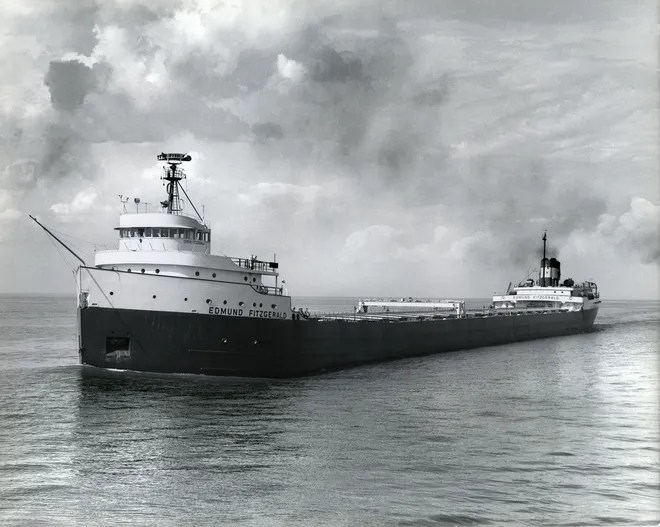
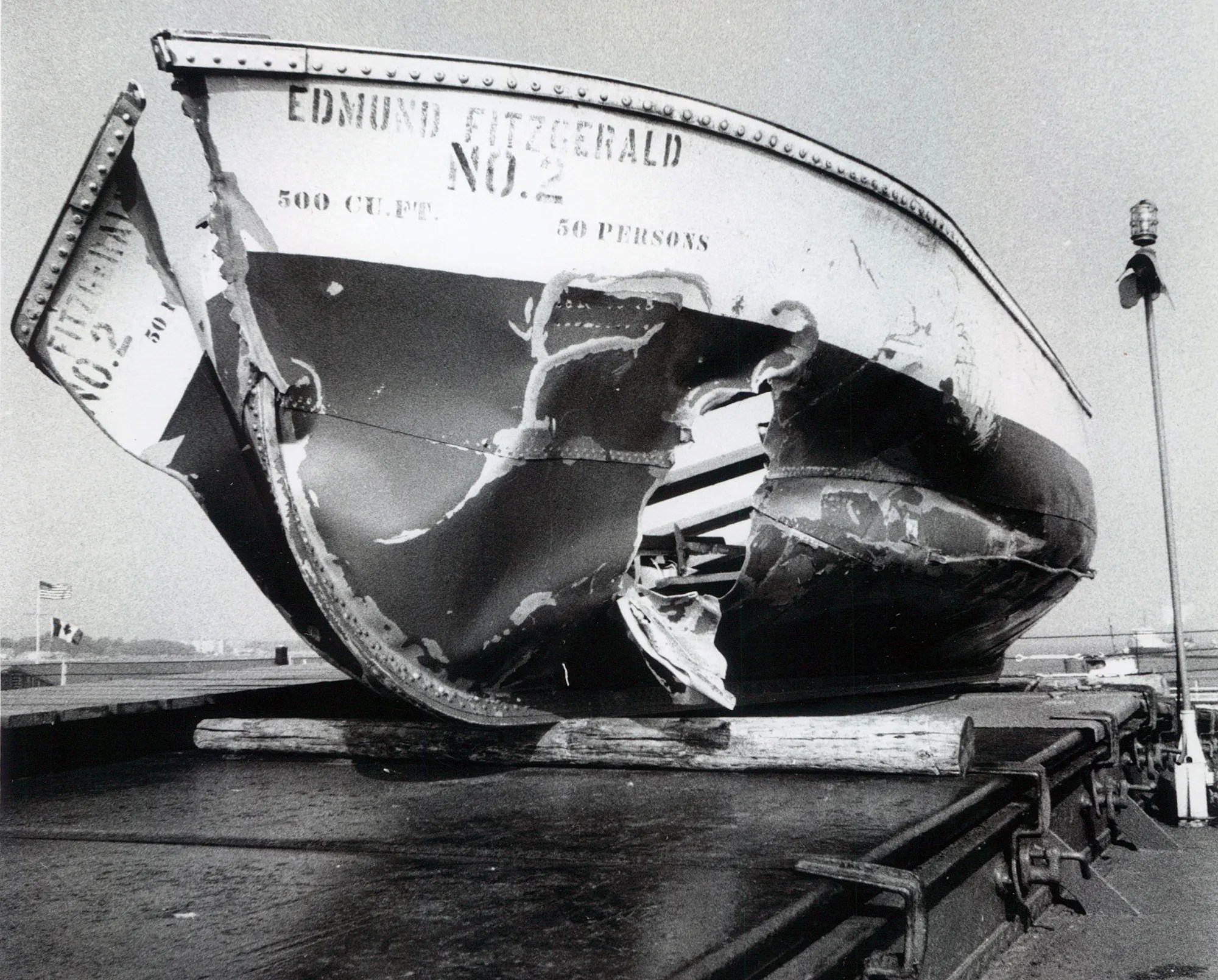

SS Edmund Fitzgerald and Recovered Damaged Lifeboat Source and Underwater Wreckage Source
- A new book called “The Gales of November: The Untold Story of the Edumund Fitgerald” by John U. Bacon (published Oct 2025) offers a definitive, deeply researched account of the 1975 sinking of the SS Edmund Fitzgerald in Lake Superior. Based on over 100 interviews, including with victims’ families and former crewmates, the book personalizes the 29 crew members and investigates the economic, industrial, and weather factors that led to the disaster.

The 210-foot long steamship SS Chicora launched in 1892 was built sturdy enough to withstand November gales on Lake Michigan and reinforced to cut through the lake’s winter ice, making her one of the first year-round enterprises between St. Joseph, Michigan, Chicago and Milwaukee. She carried both freight as well as passengers providing them a deluxe experience with her mahogany woodwork and stately rooms, the Titanic of the Great Lakes. She belonged to the steamship line known as Graham & Morton Transportation, a company proud of its safety record dating back to 1875. On January 20, 1894 the Chicora departed for Milwaukee from St. Joseph, Michigan carrying a load of dry goods, patent medicine bitters, and six passengers. The Chicora docked in Milwaukee at 5pm that day, and immediately 632 tons of flour were brought on board in 100-pound cloth sacks and barrels. Chicora departed the next morning Monday, January 21, at 5:15 am headed back to St. Joseph in calm weather. However, the barometer had suddenly dropped and a massive storm overtook her before she could reach port. Twenty-three crewmembers, including Captain Stine and his son, and one passenger never made it to port! Debris washed onto shore the following months between St. Joseph and Saugatuck, Michigan and later a sealed message in a bottle (authenticated) briefly described their last minutes. Was the ship ever found? Click the link above for the full incredible story!

The Lady Elgin was a wooden-hulled sidewheel steamship that sank in Lake Michigan off the town of Port Clinton, Illinois after she was rammed during a gale by the schooner Augusta, September 8, 1860, resulting in the loss of around 300 lives. Four years after the disaster, a new rule required sailing vessels to carry running lights. The Lady Elgin disaster remains the greatest loss of life on open water in the history of the Great Lakes. Her wreckage was discovered in 1989 off Highwood, Illinois in 60 feet of Lake Michigan water. Her artifacts have been stripped through the years.

The oldest mystery and the first big ship to sail the Great Lakes is the story of The Griffon (Le Griffon), a two mast barkentine or barque ship. Loaded with furs from what is now Green Bay, Wisconsin, The Griffon’s original and only expedition headed for Niagra Falls in 1679. The ship was said to have sunk somewhere in northern Lake Michigan. Reports by French explorers and missionaries said Native Americans told them they saw the ship go down with all hands.
Commenced by the famous French explorer, Robert de La Salle, the builders first had to build their own lodgings, and guard against attacks from the Iroquois. They had to fell great virgin trees, cut them to length and width, plane them down, shape them, and set them in the ship on-site, while a blacksmith would first have to build a forge, then create all of the metal fastenings. There was one master carpenter, one blacksmith, and ten other workmen. Cannons, rigging, chains, sails and anchors were brought in by riverboats and portages. She displayed a griffon on her bowsprit, a symbol of power, wealth, courage, and prestige and she also displayed an eagle flag.
Over 20 claims of Le Griffon’s sunken discovery have turned up unsubstantiated.
Three Additional Notorious Shipwrecks Claimed by Lake Michigan Storms


Rouse Simmons Lake Michgan Shipwreck – Captain Santa and Two Crew Members Source
The Rouse Simmons -Three Mast Schooner carrying 5,500 Christmas trees sank November, 1912, 6 miles (9.7 km) off Point Beach, Wisconsin claimed by a violent storm. The ship’s wreckage was found in 1971 by a scuba diver six miles northeast of Rawley Point in Manitowoc County, Wisconsin at a depth of 165 feet. There were no survivors among the estimated 17-member crew.

The SS Alpena – Sidewheel steamer sank October, 1812 claimed by the “Big Blow” storm while traveling from Grand Haven, Michigan, to Chicago. The vessel capsized in the middle of the lake, with wreckage, including apples and a piano, washing ashore near Holland and Saugatuck Michigan; exact loacation is unknown and the wreckage has not been found. All on board perished in the storm.
- The Saugatuck Commercial Record newspaper reported shingles, lath, lumber and other pieces from the ill-fated SS Alpena which were scattered thickly along Saugatuck, Michigan’s shores. It was also reported that thousands of apples were found bobbing on top of the lake surf at Saugatuck, Michigan.
- A beach north of Holland, Michigan, where debris was found, became known as Alpena Beach.

The SS Hennepin – First self-unloading steamer carrying crushed stone sank August 18, 1927 off the Coast of South Haven, Michigan after battling a severe squal. The ship broke apart in two which the operating company initially doubted until witness accounts confirmed it. Reports indicate that all aboard perished except for two crew members. The wreckage was found in 2006.
All rights reserved © Fossillady 2026