
I have lived less than a mile from Lake Michigan the better part of my life and even worked for ten years at one of her popular beaches called Oval Beach in Saugatuck, Michigan. The lake has blessed my life in many ways and has summoned me with a deep interest in her history, beauty and conservation! I have recorded this beauty through my photography and now it’s time to share several photos from my collection and also write about my beloved lake as well! Through this project, I was surprised to have discovered many things about the lake I had never known!

Lake Michigan Fascinating Facts Table of Contents
- Basic Statistics
- Formation
- First Inhabitants
- European Discover
- Coastline Ecology
- Animal Population

1. Lake Michigan Basic Statistics
- Lake Michigan is 321 miles (517 km) long, north to south.
- The lakes maximum width is 118 miles (190 km) across, east to west.
- The lakes narrowest width is under 50 miles (80 km) across, east to west at the southern end. Chicago to New Buffalo, Michigan.
- Average depth of the lake is 279 feet (85 m) and 923 feet (281 meters) maximum.
- Lake Michigan’s deepest region lies in the northern half called the Chippewa Basin (named after prehistoric Lake Chippewa Native Americans).


Lake Michigan Statistics Continue . . .
- Lake Michigan’s water surface area is 22,300 square miles (57,753 square kilmeters), third largest of the Great Lakes
- Lake Michigan’s water volume is 1,180 cubic miles (4,920 cubic km) second largest under Lake Superior.
- Lake Michigan has more than 1600 miles of shoreline and is the only Great Lake located completely within the United States.
- Lake Michigan is one of five Great Lakes including Lake Erie, Lake Huron, Lake Superior and Lake Ontario.
- At the south end of the lake, the Illinois Waterway provides a manmade connection to the Mississippi River and the Gulf of Mexico.
- Lake Michigan naturally flows into Lake Huron at the Straits of Mackinac.
- Lake Michigan’s Mackinac (pronounced Mac-in-awe) suspension bridge is 5 miles (8 kilometers) long connecting the upper and lower peninsulas of Michigan.
- Winter water temperatures from December to March average between 35 to 45 degrees Fahrenheit (1.6 to 7.2 Celcius).
- Summer water temperatures from June to August average between 65 to 75 degrees Fahrenheit (18.3 to 23.8 degree Celcius)
- Land use surrounding the lake is diverse with sparsely populated forested regions in the north, and urbanized and industrial centers in the south.

2. Lake Michigan and the Great Lakes Formation
Approximately 1.2 billion years ago, two tectonic plates were ripped apart, creating a mid-continental rift or crack in the earth. Eons later, around 15,000 to 10,000 years ago, the retreating mile high ice glaciers scraped through the cracks in the earth which ultimately shaped the Great Lakes leaving behind giant fresh water reservoirs from melted snow and ice.

3. Lake Michigan Coastline Regions First Human Inhabitants
- Best known for their impressive earth mounds, the Hopewell Native Americans inhabited the Lake Michigan regions as early as 400 BC, declining around 500 AD.
- Some Hopewell Native American mounds were hundreds of acres in size and contained elaborate graves with artifacts inside.
- The Hopewell’s occupied a large portion of the U.S. Midwestern States along rivers and lakes.

- Hopewell Indian Mounds Park is a prehistoric mounds site in Wyoming, Michigan that is under the protection of the Grand Rapids Public Museum.
- According to the National Park Service’s Statement of Significance: “These are the most important and best-preserved Hopewell mounds in the western Great Lakes region.
- Descendants of the Hopewell Native Americans were the Late Woodland Native Americans to which the better known tribes descended from including, the Chippewa, Menominee, Sauk, Fox, Winnebago, Miami, Ottawa, Ojibwa and Potawatomi from and early seventeenth century European explorers encountered.
- Lake Michigan’s name is derived from the Ojibwa word “Michi Gami”, meaning “large lake.”

- The Straits of Mackinac was an important Native American travel corridor and fur-trade route. The Straits of Mackinac is a narrow, roughly 5-mile-wide waterway in northern Michigan that connects Lake Michigan and Lake Huron. The staits are located between Michigan’s Upper and Lower Peninsulas, serving today as a critical shipping lane and the site of the Mackinac Bridge, which connects St. Ignace to Mackinaw City.

4. Lake Michigan European Discovery
- In 1634, the French explorer, Jean Nicolet, became the first European to set eyes upon Lake Michigan while searching for the Northwest Passage under the orders of Samuel de Champlain.
- In 1668, the Jesuit, Claude-Jean Allouez, began missionary work among the Native Americans of Green Bay and the Fox River that flows into Lake Michigan.
- In 1673, the French explorer, Louis Jolliet, and the French missionary, Jacques Marquette, mapped the lake’s western shore from Green Bay to Chicago.
- In 1679, French explorer, Robert Cavelier, sieur (lord) de la Salle, brought the first sailing ship to the lake and started the construction of Fort Miami on the bluff of what is now St. Joseph, Michigan.
- In 1785, William Burnett established a trading post with Native Americans and became the first permanent European settler in St. Joseph, Michigan.

5. Lake Michigan Coastline Ecology
- Lake Michigan coastlines display a variety of natural habitats, including, sandy beaches, forests, beach grass dunes, tall grass prairies, interdunal wetlands, bluffs and limestone bedrock.
- Lake Michigan contains interdunal coastal wetlands more than any other Great Lake created by frontal sand dune barriers.
- Due to prevailing winds, Lake Michigan’s east coast boasts the world’s largest freshwater sand dunes, particularly along the southwestern portion of Michigan; notably, Sleeping Bear Dunes National Lakeshore bluff reaching 460 feet (140 meters) high and Warren Dunes State Park, Tower Hill, reaching 240 feet (73 meters) high.


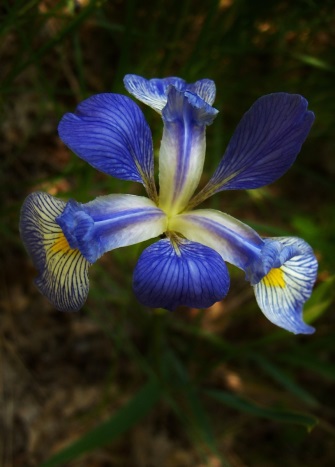


Hoary Puccoon, Wild Iris and Milkweed – Three of Lake Michigan Dunes Flowering Plants
- The common Milkweed and Hoary Puccoon are two of the most prominent flowering perennial plants along the lake’s coast. Occasional Wild Iris, Black-eyed-Susan’s, Wild Yarrow and Queen-Anne’s lace appear as well.
- Dominant tree species include the jack pine, followed by white pine. Other common trees include red pine, white spruce, red cedar, northern white cedar, cottonwood, balsam poplar, paper birch and red oaks.


Lake Michigan Dune Area Junipers, Red Cedar and Sand Cherry
- Most common shrubs include the common juniper, creeping juniper and bearberry and lesser common sand cherry.


Marram “American Beach Grass” spring shoots and mature growth in fall
The dominant Lake Michigan beach grass is the hardy, stabilizing, dune anchoring Marram Grass (American Beach Grass) and less common is the taller, prairie sand reed grass; and also lesser but also common, bluestem grass.
6. Lake Michigan Coastline Animal Population

- Lake Michigan is home to a wide range of bird populations. Some of the more prevalent birds include shore birds and wading birds such as the, sandpipers, mallard ducks, Canadian geese, common terns, ring-billed gulls, herring gulls, sandhill cranes, great blue heron, trumpeter swans and tundra swans. A rare piping plover is sometimes spotted as well. Many song birds, crows and vultures are a common sight near Lake Michigan. I personally have witnessed many a crow and gull scavenging dead fish washed up on shore. Predatory birds such as bald eagles, ospreys and various hawks including broad-winged, red-shouldered, red-winged and red-tailed hawks are also prevalent.

- The Kirtland’s warbler, a small yellow songbird that breeds almost exclusively in the Great Lakes Basin, hovered on the edge of extinction in 1974, but has been taken off the endangered list thanks to efforts by the Great Lakes Restoration Initiative, accomplished partly by replenishing their breeding habitat of jack pine forests.

- Beaver, muskrat, river otter, mink, turtles and frogs, including a rare species called, Blanchard’s Cricket Frog are prevalent along Lake Michigan’s coastal wetlands.

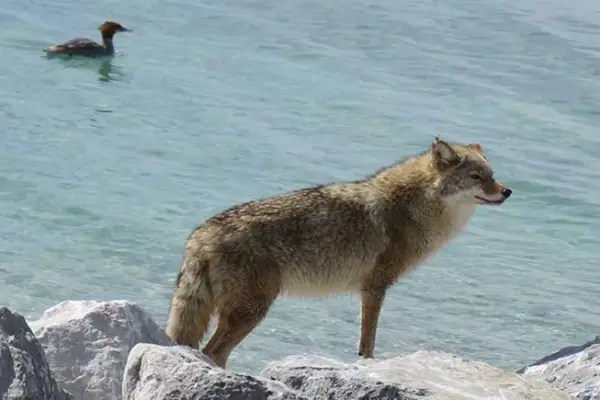
- Moose, black bear and the gray wolf are found in the Upper Peninsula, while fox, coyotes and white tail deer are fairly common up and down the coasts.


All rights reserved © Fossillady 2026